
Traducción al español por María Del Castillo Sucerquia*
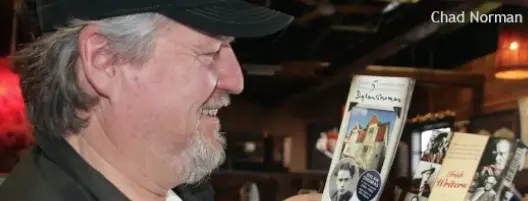
Dependiendo de su contexto y tiempo, leer a poetas extranjeros nos acerca a su manera de sentir, ver y ser en el orbe, para y/o desde su terruño. Hoy en Cronopio Errante, columna de traducción, les presento un paladeo del trabajo poético del autor canadiense Chad Norman.
Chad Norman. (Nueva Escocia, Canadá). Poeta. Ganó el Premio Memorial Gwendolyn MacEwen (1992) de Poesía. Su libro más reciente es Parental Forest, fue publicado por AOS Publishing. Su poema, The Shoulds, incluido en la Lunar Vagabond Collection, forma parte de una cápsula del tiempo que fue enviada a la luna el 26 de febrero de 2025.
THE SHOULDS
for the people of Ukraine
My wish is
to stop all current wars,
a wish playing
in my mind
like a song I do not like;
to think of
all the women
who have watched
the last breath
leave their men;
a love supreme
given by Coltrane
that year I was six
and still the love
I look for today;
all the hungry
no longer in line-ups
seated at tables
they set for the meals
they will slowly savour;
to enjoy the weeds
that stop being beautiful
due to the cold
but remain in bloom
in my generous memory;
to free my wife
from the greedy virus
shared with her
by a son turned 18
and ready for early manhood;
all the world’s politicians
taken on a picnic
where there’s a table
they can carve
their little names into;
and you & I then
can remove doubt
from all possibilities
we know should alter
the minds of those
who wish to go on
beside us, yes,
right beside us.
LAS POSIBILIDADES
para el pueblo de Ucrania
Mi sueño es
detener todas las guerras,
un anhelo que suena
en mi mente
como una canción que no me gusta;
pienso en
todas las mujeres
que han visto
cómo el último aliento
abandona a sus hombres;
en el amor supremo
dado por Coltrane
el año en que tenía seis,
aquel amor que
todavía busco hoy.
Deseo mirar a todos los hambrientos,
ya no en filas,
sentados en mesas
que ellos mismos ponen
para las comidas
que saborearán con deleite;
disfrutar las hierbas
cuya belleza pierden
por el frío,
pero siguen floreciendo
en mi generosa memoria;
liberar a mi esposa
de nuestro virus codicioso
por un hijo que cumple 18
y está listo para enfrentar el mundo;
llevar a todos los políticos
a un picnic donde
hay una mesa
en la que pueden tallar
sus pequeños nombres;
y tú y yo, entonces,
quitarnos la duda
de todas las posibilidades
que, sabemos, deberían alterar
las mentes de aquellos
que desean seguir
a nuestro lado, sí,
justo a nuestro lado.
* * *
WITHOUT A HOME
- Cardboard
Between you
and the sidewalk
a piece
found somewhere,
a thickness
near nonexistent
is to be
a mattress,
what I see
walking by
or from a taxi,
during a brief stay
in Montreal.
But if I know
anything
because of my travels,
I know you
are not warm,
you are surrounded
by what the state
of your mind
says is a home,
a lie I will not
believe, or allow
to say you are not
without a home.
- Concrete
Seeing you in there,
another doorway
I wonder if it is
your favourite, the one
where I could come
and lay down too,
and know
my body is without a home,
is a body now
taught by
other than placing
a finger
or a cheek against
a wall inside my home,
a wall strangely cold,
a wall of the home
I pay to own,
don’t always believe
I really own.
I see you under
what appears to be blankets,
huge types of blurry coats,
perhaps I don’t
really see you, really get
the feeling of concrete
when it is truly unknowable,
how you feel it,
each day, each night,
when the body craves
any type of heat,
or better yet, any type
of human acceptance,
to the point of
me wanting to stop
the cab I am in,
and join you
to provide at least
that warmth
two bodies can share.
- Cloth
Watching the meter
rapidly add up
seated in the front
I take the sleeve
of my sweater
sticking out of
the winter coat I wear
between my fingers
none of them cold
or without a home,
and think of the cloth
close to you, the cloth
hopefully causing warmth,
close to your skin
where you also find yourself,
the skin
you were born into,
covered with
what the cloth is,
a tee-shirt,
an outer shirt you
consider an old-time
favourite, the cloth
of another shirt being
another layer,
and even though it is
a distance from
your skin, your self,
I feel my hope
taking on a voice,
a voice saying out loud,
may there be
the cloth of a sweater
like I am holding
also helping to allow
you a belief in at least
one thought, one decision
causing the doorway,
your home for now,
to be empty
before night brings
what little it always has.
SIN UN HOGAR
- Cartón
Entre tú
y la acera,
un pedazo
encontrado en algún lugar,
con un grosor
casi inexistente,
que se convierte
en un colchón,
lo que veo
al caminar
o desde un taxi,
durante una breve estadía
en Montreal.
Pero si algo sé
por mis viajes,
es que tú
no eres cálido,
estás rodeado
por lo que tu mente
dice que es un hogar,
una mentira que no
creeré, no aceptaré
que digan que no estás
sin un hogar.
- Concreto
Viéndote allí,
detrás de otra puerta,
me pregunto si es
tu favorita, esa
donde podría llegar
y acostarme también
y saber
que mi cuerpo está
sin un hogar,
este cuerpo ahora
educado por
algo más que el simple
gesto de poner
un dedo
o una mejilla contra
una pared dentro de mi hogar,
una pared extrañamente fría,
una pared del hogar
que pago para ser dueño,
aunque no siempre creo serlo.
Te veo bajo
lo que parecen mantas,
grandes abrigos borrosos,
quizá no te
veo realmente, no entiendo
la sensación del concreto
cuando es incognoscible,
cómo lo sientes,
cada día, cada noche,
cuando el cuerpo anhela
cualquier tipo de calor,
o mejor aún, cualquier tipo
de aceptación humana,
hasta el punto de
querer detener el taxi en el que voy,
y unirme a ti
para ofrecer al menos
ese calor
que dos cuerpos pueden compartir.
III. Tela
Viendo cómo sube el medidor,
sentado al frente,
tomo la manga
de mi suéter,
que sobresale
del abrigo de invierno que llevo,
entre mis dedos,
ninguno de ellos frío
o sin un hogar,
y pienso en la tela,
cerca de ti, la tela
que, con suerte, produce calor,
cerca de tu piel,
donde también te encuentras,
la piel
en la que naciste,
cubierta con
lo que la tela es:
una camiseta,
una camisa vieja que
consideras tu favorita, la tela
de otra camisa que es
otra capa.
Y aunque está
a una distancia de
tu piel, tu ser,
siento mi esperanza
tomando una voz,
una voz que dice en voz alta,
que existe
la tela de un suéter
como el que estoy sosteniendo,
también ayudando a permitir
que tengas fe, al menos
en un pensamiento, una decisión
que abra la puerta
y tu hogar, por ahora,
quede vacío
antes de que la noche traiga
lo poco que siempre ha traído.
* * *
THE GOOD IN US
for James Walsh, singer for StarSailor
When my passing through is over,
when a woman smiles as she cries,
when my country stops being involved,
when that involvement isn’t about wars,
when my country is really a peace-keeper,
I will know the good in us.
As my living becomes a dying,
as a man cries as he smiles,
as my life no longer includes greed,
as that greed wakes up with guilt,
as my wish takes over all doubts,
I can know the good in us.
Our tears are caused by a voice,
our voices can never be just noise,
our routines own everything we own,
our homes do not need large yards,
our properties belong to unhappy strangers,
I should know the good in us.
To fall over the top of a piano,
to punch a clock in order to be abused,
to sit on one side of a dirty window,
to sip a blend of fine coffee and rum,
to cry when a branch sways slowly,
I claim the good in us.
The good in us.
The good in us.
I see into the troubled now,
and hear a song so loud
I wonder if anyone else
can hear it, no, I wonder
why it plays so loudly for me,
I wonder if all of you
also feel and believe in
the good in us, knowing
it is there if we want it?
LO BUENO EN NOSOTROS
para James Walsh, cantante de StarSailor
Cuando mi paso por aquí termine,
cuando una mujer sonría mientras llora,
cuando mi país deje de involucrarse,
cuando esa intervención no trate de guerras,
cuando mi país sea un verdadero pacificador,
conoceré lo bueno en nosotros.
A medida que mi vida se torne mi muerte,
a medida que un hombre llora mientras sonríe,
cuando se esfume de mi vida la codicia,
cuando esa codicia despierte con remordimiento,
cuando mi deseo se apodere de todas las dudas,
podré conocer lo bueno en nosotros.
Nuestras lágrimas son causadas por una voz,
nuestras voces nunca pueden ser solo ruido,
nuestras rutinas poseen todo lo que poseemos,
nuestros hogares no necesitan grandes patios,
nuestras propiedades pertenecen a extraños infelices:
me urge conocer lo bueno en nosotros.
Y caer sobre la parte superior de un piano,
golpear un reloj para ser maltratado,
sentarme de un lado de una ventana sucia,
beber una mezcla de buen café y ron,
llorar cuando una rama se balancea lentamente:
reclamo lo bueno en nosotros.
Lo bueno en nosotros.
Lo bueno en nosotros.
Contemplo en el ahora perturbado,
y escucho una canción tan fuerte
que me pregunto si alguien más
puede escucharla, no, me pregunto
por qué suena tan fuerte para mí,
me pregunto si todos ustedes
también sienten y creen en
lo bueno en nosotros, si saben
que está ahí si lo queremos.
* * *
RETIREMENTAL SPRING
for Chelsea S.
There is a tree to visit
few care of the year,
a bark beneath the finger
daring to place a print.
One voice tries to suppress
another offers a new singer;
we are on our way
to dance on the exposed roots.
Time has limped through
wearing away the earth too,
soil tucked in a child’s tread,
a boot keeping her dry.
We can finally sit down
bark now at our backs,
softly we exchange skins,
our seasonal flows.
All around us
it wants to be green,
there is only dead grass,
only our initial longing.
To look up into branches
as all the buds look down;
we are to be trusted,
let the world know us
sap as blood, blood as sap.
PRIMAVERA DE JUBILACIÓN
para Chelsea S.
Hay un árbol por visitar
que nadie cuida durante el año,
una corteza bajo el dedo que
se atreve a dejar una huella.
Una voz trata de suprimir,
mientras la otra ofrece un nuevo canto;
vamos en camino
a bailar sobre las raíces al descubierto.
El tiempo ha cojeado,
ha desgastado la tierra.
El suelo guardado en la pisada de un niño,
permanece en una bota que la mantiene seca.
Finalmente nos sentamos,
con la corteza ahora a nuestras espaldas,
intercambiando pieles, nuestros flujos
estacionales, con suavidad.
A nuestro alrededor
hay un anhelo de verde,
solo hay pasto muerto,
solo nuestro anhelo inicial.
Miramos hacia arriba entre las ramas,
mientras todos los brotes miran hacia abajo;
debemos ser dignos de confianza,
dejar que el mundo nos conozca
savia como sangre, sangre como savia.
___________
* María del Castillo Sucerquia (Barranquilla, Colombia – 1997). Poeta, traductora (francés, inglés, italiano, portugués y griego), agente literaria, terapeuta en medicina oriental (Escuela Neijing, España). Aprendió idiomas en la Universidad del Atlántico. Estudiante de idioma hebreo. Ganadora del premio de poesía Naji Naaman, categoría Creativity prize, (Líbano, 2022); del premio «Un poema para Meira Delmar» – 2022 (Biblioteca Meira Delmar, Barranquilla, Colombia); del premio Golden Heart, que otorga la Fundación Internacional Rahim Karim Karimov (Rusia–Kirguistán, 2022), en reconocimiento a su labor literaria y de traducción; del primer puesto del VII premio Mesa de Jóvenes «Jorge García Usta» (Festival Internacional PoemaRío – Biblioteca Piloto del Caribe) con su libro «El tren silenciado», entre otros reconocimientos. Directora de la revista Read Carpet Colombia. Curadora y traductora de revistas literarias y medios nacionales e internacionales. Sus poemas han sido traducidos al chino, inglés, canarés, bengalí, polaco, entre otros, y publicados en antologías y medios digitales e impresos nacionales e internacionales.